 N環球

Delhi air improves slightly to AQI 307, still 'very poor', after worst Diwali in five years
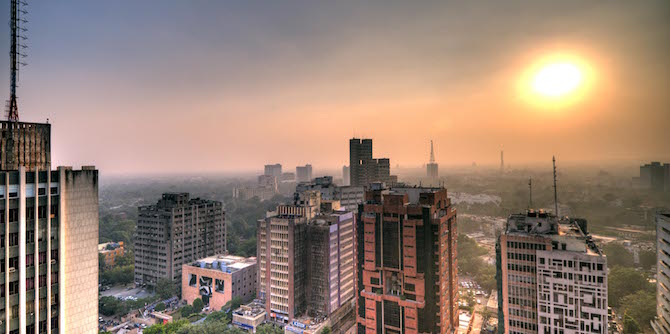
On the second day after Diwali, Delhi's air quality index eased to 307 on Tuesday morning, still in the 'very poor' category. With no rain forecast for five days and light winds, pollution is unlikely to clear quickly, and Stage III restrictions under the Graded Response Action Plan remain in force.
India's capital New Delhi saw a slight improvement in air quality on Tuesday morning (10 November), with the air quality index (AQI) at 307, still in the 'very poor' category. Fireworks during Diwali sharply worsened the capital's air, and Monday morning's AQI of 368 to 371 was the worst post-Diwali morning reading since 2021.
Chandni Chowk near 400
According to the Central Pollution Control Board (CPCB), the citywide average AQI was 307 at about 7 to 8 a.m. on Tuesday, down roughly 60 points from Monday. The most polluted monitoring stations were Chandni Chowk and Pusa, both at 395, followed by NSUT Jaffarpur at 382 and the Commonwealth Games Sports Complex area at 380. Fine particulate matter PM2.5 stood at 384 micrograms per cubic metre, and PM10 at 181.
Diwali-day AQI of 376, worst in five years
Diwali was celebrated on Sunday 8 November, when the citywide average AQI reached 376 at 4 p.m., the highest Diwali-day reading since 2021, above 345 in 2025, 328 in 2024, 218 in 2023 and 312 in 2022. Around midnight, average PM2.5 concentrations peaked at 671.1 micrograms per cubic metre; the Mundka monitoring station recorded 3,744 micrograms per cubic metre at about 2 a.m. on 9 November. Delhi Police have registered more than 200 cases for violating firecracker restrictions, and a complete ban on bursting firecrackers came into effect in the capital from 9 November.
No rain for five days; Stage III curbs continue
The India Meteorological Department forecasts no rainfall in Delhi from 10 to 15 November, with wind speeds of 5 to 15 kmph and moderate fog persisting for about five days, limiting the dispersal of pollutants. Stage III restrictions under the Graded Response Action Plan (GRAP) remain in force, including bans on BS-III petrol and BS-IV diesel vehicles and a halt to dust-generating construction and demolition, while water sprinklers have been deployed across the city. On 9 November, Swiss air-quality monitor IQAir ranked Delhi the world's third most polluted city.
Source: Central Pollution Control Board; India Meteorological Department; Times of India; PTI, 10 November 2026.
💬 Comments
No comments yet. Be the first!