 N環球

Harvard Photonic Chip Produces 120 Times More UV Light, a Step Toward Smaller Quantum Computers
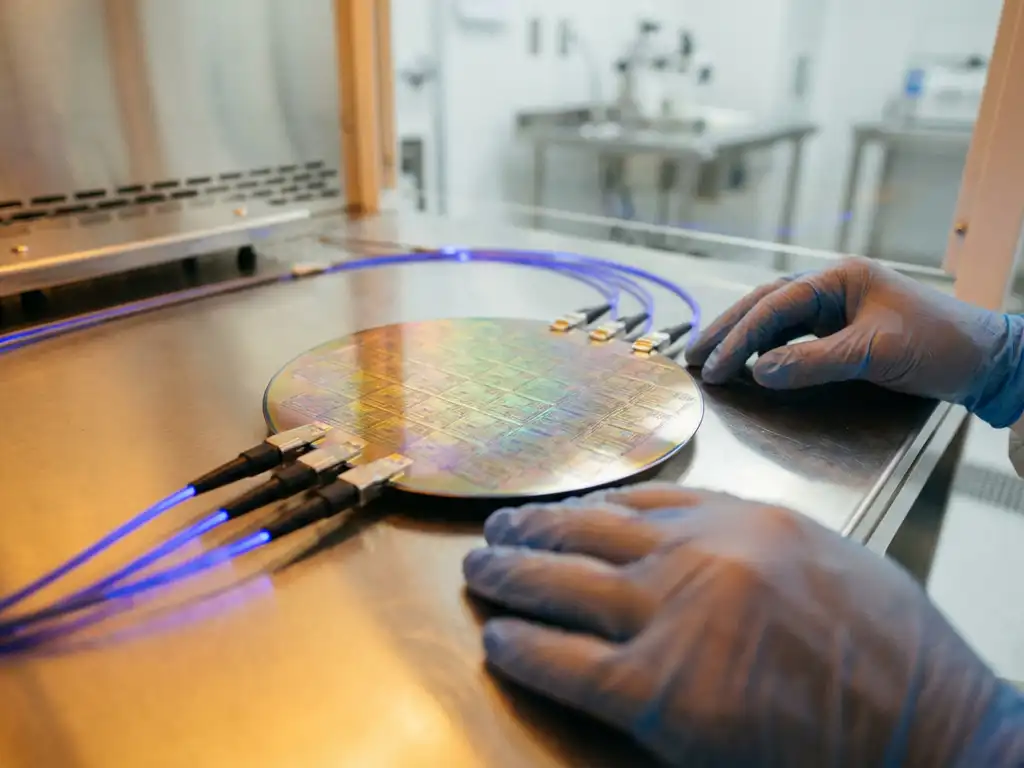
A Harvard research team has generated 4.2 milliwatts of ultraviolet light on a thin-film lithium niobate chip at a wavelength of 390 nanometres — about 120 times the output of previous comparable devices. Published in Nature Communications, the work could help shrink quantum computers, atomic clocks and environmental sensors.
A Harvard research team has generated 4.2 milliwatts of ultraviolet light directly on a thin-film lithium niobate chip, at a wavelength of 390 nanometres — about 120 times the output of previous comparable devices. The results, published in Nature Communications, could help shrink quantum computers, atomic clocks and environmental sensors. Harvard's School of Engineering and Applied Sciences announced the work on Thursday (November 26).
Making UV light from red light inside the chip
Rather than trying to deliver ultraviolet light through microscopic channels, the team generates it inside the chip itself: through frequency upconversion, two red-light photons combine into one ultraviolet photon. The key technique is “sidewall poling” — placing electrodes alongside the waveguide to reverse the crystal's orientation with about 50-nanometre precision — combined with “adapted poling” that fine-tunes the spacing of the reversed regions to compensate for variations in film thickness and waveguide shape, resolving the old trade-off between correcting imperfections and maintaining conversion efficiency.
Applications: smaller quantum computers and precise clocks
Ultraviolet light is essential for trapped-ion quantum computers, whose atomic transitions often lie in the near-ultraviolet; current systems rely on bulky external UV lasers. A milliwatt-level on-chip UV source could compress the whole optical system onto a chip. Ultra-precise atomic clocks and compact environmental sensors would benefit as well. The work was carried out by the team in Marko Lončar's laboratory; the paper is titled “Milliwatt-level UV generation using sidewall poled lithium niobate.”
The photo shows a photonic chip wafer, a file image; it is not the device described in this article. (Image: PhotonDelta)
💬 Comments
No comments yet. Be the first!