 N環球

US Air Force seeks private capital for a 30,000-GPU aerospace AI supercomputer
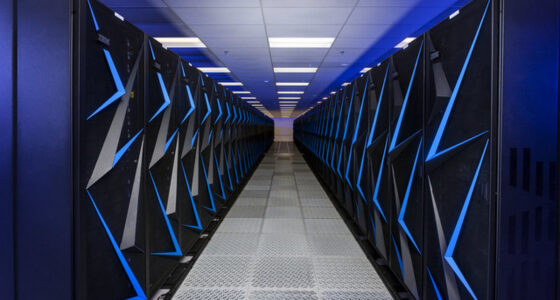
The Air Force District of Washington posted a sources-sought notice on SAM.gov on 25 November, exploring commercial and public-private models for a purpose-built aerospace high-performance computing and AI supercomputer of about 30,000 GPU equivalents, with roughly $2 billion in computing equipment and data centre facilities. The notice is market research, not a procurement, and the government does not commit to awarding a contract; responses are due 11 December.
The U.S. Air Force plans to build an aerospace supercomputer of about 30,000 GPUs, and it is asking private capital how to pay for it. The Air Force District of Washington posted a sources-sought notice on the federal procurement site SAM.gov on 25 November, exploring commercial and public-private models for a purpose-built aerospace high-performance computing (HPC) and artificial intelligence supercomputer, with about $2 billion in computing equipment and data centre facilities.
30,000 GPUs for aerospace simulation and AI training
According to the notice, the supercomputer would be optimised for complex tensor operations, physical AI, large-model training and dense scientific simulation — in practice, fluid dynamics and solving partial differential equations, the core mathematics of aerospace design. The notice also asks respondents to compare GPUs with CPU-centric clusters on that kind of computing. The system would have to host unclassified commercial tenants alongside Secret, Top Secret and Special Access Program enclaves, with protection against model-weight extraction and side-channel leakage.
Private financing is the central question
The heart of the notice is money, not silicon: the Air Force asks what financing instruments, equity hurdle rates and debt tenors private capital would require to fund the roughly $2 billion build on federally leased land; what step-in rights lenders would demand if an operator defaulted; and how much development capital a consortium would need before any revenue arrives. It also wants to know whether commercial customers would sign take-or-pay or anchor-tenant commitments and accept second place on a machine the military can always bump them from. The site starts with only about 750 kW of power, scaling to a substation capacity of up to 30 MW plus an additional 30 MW pad and battery storage; racks of 100 kW and above would need liquid or immersion cooling. The facility must operate for at least 20 years, even though its AI computing equipment is expected to become obsolete in three to five.
Market research, not a procurement
The notice states plainly that it is market research, not a request for proposals, and that the government does not commit to awarding a contract to respondents. Questions are due by 2 December and responses by 4 p.m. ET on 11 December; the notice closes on 26 December. Those invited to respond include HPC providers, hyperscalers, data centre infrastructure developers, private equity and infrastructure financiers, and academic institutions. In June, the Air Force Research Laboratory switched on a 14-petaflop supercomputer at Wright-Patterson Air Force Base in Ohio, its tenth there; the facility in this notice would be an eleventh.
(Sources: SAM.gov, Data Center Dynamics, Interesting Engineering, 25–27 November 2026)
💬 Comments
No comments yet. Be the first!