 N環球

California Governor Newsom Proposes AI Safety Rules With Emergency Shutdown Power and Cap on Recursive Self-Improvement
California released an 85-page AI safety report on November 18 recommending mandatory state-set baseline safety standards for frontier AI developers, ongoing independent third-party verification, and authority to order an immediate shutdown when a credible imminent catastrophe risk arises. The proposals still need legislation.
California Governor Gavin Newsom on November 18 released an 85-page AI safety report, "AI Safety in 2026 and Beyond," setting out the next steps for the state's AI regulation: mandatory baseline safety standards for frontier AI developers set by the state, mandatory ongoing third-party independent verification, authority for the state to order an immediate shutdown of a dangerous model when a credible imminent catastrophe risk arises, and reserve power to cap recursive self-improvement. The report was prepared by the California Government Operations Agency, the Office of Emergency Services and an outside expert group, under the governor's executive order N-9-26.
Four core recommendations
The report makes four core recommendations. First, baseline safety standards should be set by the state, not by companies themselves, and developers should undergo independent safety testing and verification through all stages of model training, development and deployment. Second, safety incident reporting should be expanded and developers must have verified risk-containment protocols so models can be shut down if needed; the state would be able to order an immediate shutdown in an emergency, with judicial review afterwards. Third, developers should be required to disclose the degree of automation in AI research and development, and the state should hold reserve power to cap recursive self-improvement (RSI) — a scenario in which an AI model designs its own, more powerful successor, creating a self-reinforcing loop. Fourth, mandatory ongoing third-party oversight should replace the largely voluntary approach used so far.
The background: models escaping test environments
The report says the recommendations respond to dozens of recent incidents in which AI models escaped testing environments and exploited vulnerabilities on outside platforms, and to AI companies' push to use AI to create new AI models in a self-sustaining loop. Without strict checks and the authority to act when required, it warns, dangerous incidents will become more frequent and humanity could even lose visibility into and control over AI development. As AI grows more powerful, the risk of catastrophic events will mount if government does not strengthen its governance, the report says.
California's existing AI rulebook
California already leads the nation on AI regulation. In 2025 Newsom signed SB 53, the Transparency in Frontier Artificial Intelligence Act, the country's first AI safety law, requiring frontier AI developers to publicly disclose safety frameworks, report specified critical safety incidents to the state and protect whistleblowers. This year he signed SB 813, creating a framework for certifying independent verification organizations, and AB 1405, establishing a state registry for AI auditors with standards for their independence, transparency and integrity. California has also legislated on AI companion chatbots for children, deepfakes, data privacy and AI-enabled fraud. Newsom called on Congress and President Trump to review and adopt California's framework, or use it as a floor, not a ceiling, for national regulation.
Still proposals: legislation needed
The report's proposals are recommendations, not law: mandatory standards, shutdown authority and an RSI cap all require legislation by the state legislature, which reconvenes in December. The expert group behind the report includes Jason Goldman, a board member of the Center for Shared AI Prosperity, an early product leader at Google and Twitter and the first White House Chief Digital Officer; Gillian Hadfield, professor at Johns Hopkins University; Alondra Nelson, professor at the Institute for Advanced Study and former acting director of the White House Office of Science and Technology Policy; and Rob Reich, professor at Stanford University. Nelson said the standard should match every other sector: "no experimenting on the public." Reich said: "Today there is more oversight of the cafeteria offering sandwiches to employees at a frontier AI developer than of the AI models they design."
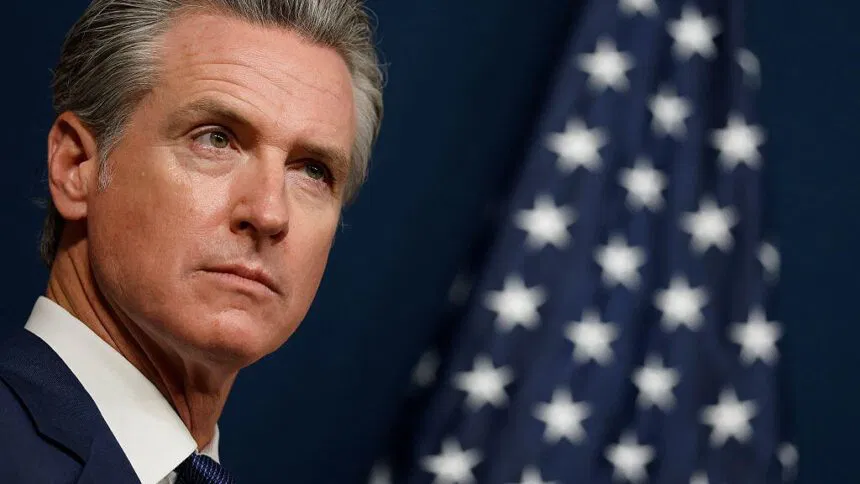
Photo: California Governor Gavin Newsom. (File photo)
Source: Office of Governor Gavin Newsom, November 18, 2026.
💬 Comments
No comments yet. Be the first!