 N環球

SpaceX Starship to attempt first land catch of spacecraft in 15th flight tonight
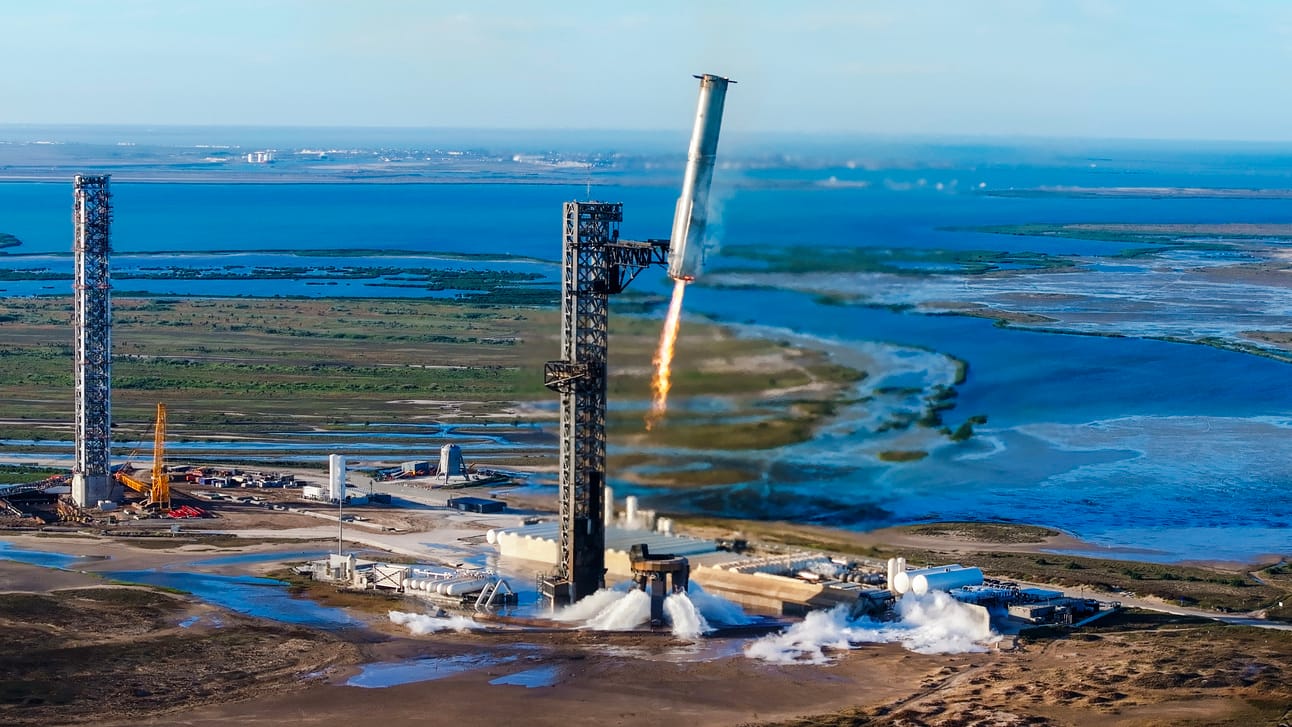
SpaceX's Starship is set to launch at 5:45 p.m. EST on Friday for its 15th flight, attempting for the first time to catch the returning spacecraft on land while deploying 26 Starlink V3 satellites.
SpaceX's Starship is scheduled to lift off at 5:45 p.m. EST on Friday, November 13, from Starbase in Texas, for its 15th flight since 2023. The mission will include the first attempt to catch the returning spacecraft on land with the launch tower's mechanical arms, rather than discarding it in the ocean — a key test of SpaceX's bid to make a fully reusable rocket system.
According to Reuters, the 124-metre-tall rocket will launch within a 75-minute window opening at 4:45 p.m. CT. It is the second Starship flight to carry a batch of operational Starlink satellites, with 26 Starlink V3 satellites headed for orbit at about 275 km. The spacecraft will circle Earth about 14 times and coast for roughly 21 to 22 hours before returning, with the catch expected at about 2:45 p.m. CT on Saturday, November 14.
Launch licence still pending on Friday morning
As of Friday morning, SpaceX had not received a launch licence from the US Federal Aviation Administration. The FAA has typically issued licences a day before past Starship launches, and did not immediately respond to a request for comment. SpaceX said on social media that Flight 15 was "targeting to launch as early as Friday, November 13, pending regulatory approval".
Catching both stages
The mission aims to bring both parts of Starship back to Texas: the Super Heavy booster will fall back vertically into the tower's arms about 10 minutes after launch — SpaceX has caught the booster three times before, most recently in March 2025 — while the spacecraft, Ship 42, returns after completing 14 orbits. The booster must first be moved off the launchpad to make way for the spacecraft, whose land catch is expected about 22 hours after liftoff. SpaceX has said it would be a "breakthrough moment in making Starship a reliable, rapidly reusable rocket" if all goes as planned.
SpaceX has contingency plans if the spacecraft runs into trouble in orbit: five pre-designated splashdown areas in the Indian Ocean, the Pacific Ocean and the Gulf of America, and the vehicle could be destroyed in the air if proceeding is no longer safe. On its return, the spacecraft will fly over inhabited areas in Mexico and southern Texas, and residents of Cameron County, Texas, may hear one or more sonic booms.
Last flight lasted only about three hours
Starship last flew on September 28, taking the rocket and its satellites to orbit for the first time, but some engines shut down mid-flight and the mission, planned to last 10 hours, ended after roughly three hours with an intact splashdown in the Pacific Ocean. If Flight 15 runs its full course, it will be Starship's longest and most complex mission yet, and its second orbital flight.
Starship and the Moon programme
Elon Musk views Starship as crucial to expanding the Starlink network and, in the future, deploying a vast swarm of AI data-processing satellites called Starmind. NASA has provided about $3.2 billion since selecting Starship in 2021 as the moon lander for its Artemis programme, and SpaceX has put at least $15 billion of its own funds into the rocket's development. NASA and SpaceX expect Starship to land humans on the Moon by 2028, though several major testing milestones remain — including demonstrating complex fuel transfers between tanker rockets in orbit — which analysts and industry engineers believe will push that timeline back. Musk has said he expects to reach a weekly launch cadence by the first half of 2027, and SpaceX has said it could begin launching Starship from a new Florida launchpad by the end of 2026.
(File photo: a Starship test flight. Image: SpaceX)
💬 Comments
No comments yet. Be the first!