 N環球

China's Anatrix Unveils AX100 Analog Chip That Solves a Matrix Equation in Under 100 Nanoseconds
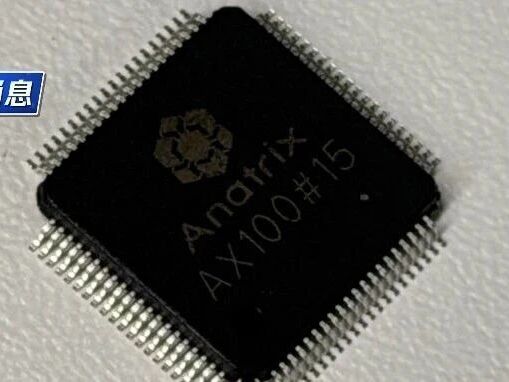
Anatrix says the AX100 is the world's first fully integrated analog computing chip that solves matrix equations in a single step. Tape-out was completed in October, with each solve taking under 100 nanoseconds at about 80 milliwatts.
Chinese analog computing chip developer Anatrix announced on November 15 that its self-developed AX100 chip completed tape-out in October. The company describes it as the world's first fully integrated analog computing chip capable of solving matrix equations in a single step. In tests, a single matrix equation solve took under 100 nanoseconds and consumed about 80 milliwatts of power, in line with theoretical simulations and design expectations, the Science and Technology Daily reported.
The Matrix Becomes a Circuit
Matrix equations sit at the heart of AI model training, robot motion control and wireless signal processing. Conventional digital chips solve them through a sequence of calculations, while the AX100 maps the equation directly onto an electrical circuit and reads out the answer once the circuit settles into equilibrium, with no iteration. Anatrix chief executive Xiang Rui said the AX100 is fundamentally different from GPU-style digital chips in architecture and underlying logic, and gives a Chinese company a first opportunity to help define an important computing paradigm.
Test Results Across Three Applications
Anatrix tested the chip in three areas. In AI training, using a 2.93-million-parameter autoencoder model and a 2.72-million-parameter Transformer model, the method cut the computing cost of updating model parameters by 92 percent and 56 percent respectively. In embodied AI, the tests showed faster motion control and route planning, which could help robots respond more quickly as their surroundings change. In wireless communications, for a 128-by-128 channel Gram matrix, the analog chip delivered 20 to 207 times the equivalent throughput and 27.6 to 61.3 times the equivalent energy efficiency of the digital ASIC chips and GPUs used for comparison.
From Peking University Research to the Production Line
The AX100 builds on research published by a Peking University team led by Sun Zhong in Nature Electronics in October 2025, which raised analog computing precision from around one percent to one part in ten million, with a single solve three orders of magnitude faster than advanced GPUs and two orders more energy efficient. Within about a year of publication, Anatrix moved the technology from the laboratory to the production line. The company said the chip can be manufactured using mature production processes, without the most advanced nodes.
The "world's first" description and the test figures are the company's own claims and have not been independently verified, and completing tape-out is not the same as mass production. Whether the chip can sustain the same precision and efficiency in large-scale real-world use still awaits further public testing and industry validation.
💬 Comments
No comments yet. Be the first!