 N環球

Chip giants pivot to the edge at CIIE as AI inference spending overtakes training for the first time
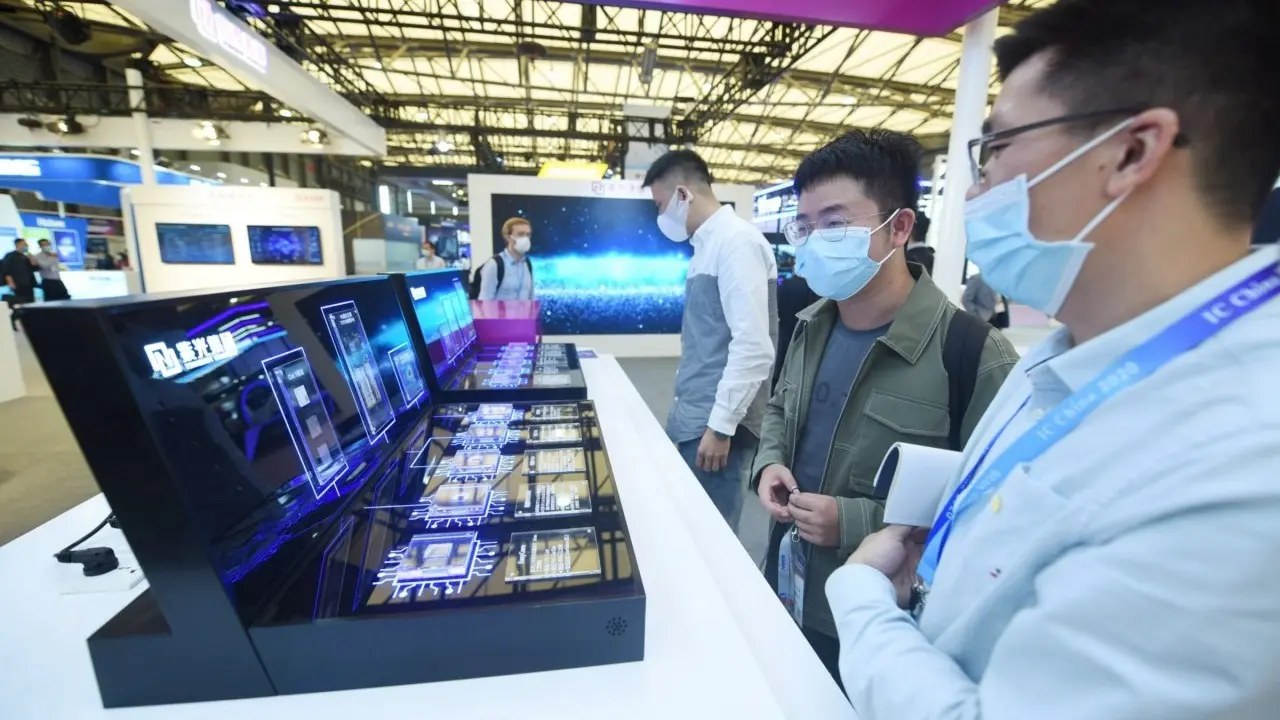
At the 9th China International Import Expo, which opened in Shanghai on November 5, Qualcomm, Samsung, Intel, AMD, SK Hynix and others all put real-world AI deployment at the centre of their booths. Gartner forecasts global AI inference spending will reach $23.3 billion in 2026, passing $19 billion for training.
The 9th China International Import Expo (CIIE) opened in Shanghai on November 5, and its technology and equipment hall has become a barometer for the global semiconductor industry. Qualcomm, Samsung, Intel, AMD, SK Hynix, Synopsys and other vendors all put the real-world deployment of AI at the centre of their booths — a sign that the centre of gravity for computing is shifting from cloud-based training toward inference and the device edge.
Inference passes training for the first time
A Gartner forecast released in August projects worldwide spending on AI-optimized infrastructure-as-a-service will reach $42.3 billion in 2026, up 96% year on year. Of that total, $23.3 billion will go to inference and $19 billion to training — the first year inference has overtaken training. Inference will account for 55% of AI-optimized IaaS spending in 2026, rising to 59% in 2027. Gartner attributes the shift to enterprises moving from model development to production-scale deployment, where fine-tuned, domain-specific models run continuously inside customer-facing systems.
Qualcomm bets on the device: 6G prototype and on-device models
Qualcomm publicly demonstrated a 6G terminal prototype conforming to the latest 3GPP definition for the first time, and said it is conducting joint 6G testing and interoperability verification with Chinese partners including China Mobile and ZTE, with commercialization expected gradually over the next two years. On the device side, Qualcomm worked with StepFun, Infris AI and Longsys to run a 30-billion-parameter mixture-of-experts model entirely on a smartphone, extending on-device AI to more complex agent applications. Agent products powered by Snapdragon platforms, such as the Honor Robot Phone and Nubia NaviX Ultra, drew crowds of visitors to try them.
AMD pushes local agent hosts; Intel says compute must move closer to scenarios
AMD positioned the “agent host” as a concrete vehicle for AI deployment. A host based on the Ryzen AI Max+ PRO 495 platform, equipped with 192GB of unified memory, can run large models locally and support parallel multi-agent operation, offering developers, one-person companies and small businesses a deployment option that does not go to the cloud. Booth staff said an intelligent bidding appliance compresses the processing of bidding documents from “three people, seven days” to “one person, half a day,” while a legal-assistant host handles contract review and drafting, with local deployment protecting sensitive information.
Wang Zhicong, chairman of Intel China, said in an interview during the expo that more AI compute will be deployed on the inference and edge side over the next five years, because “compute needs to be closer to the data, closer to the scenarios and closer to the users.” Two years ago the industry talked most about large-model performance and training, he said; today the focus is more on agents, “which is really about inference.” Intel showcased a full-stack computing matrix based on its 18A process and launched a green-power energy-storage computing solution and a token all-in-one machine.
Memory giants double down as shortages persist
As large models keep scaling, they demand more memory capacity, bandwidth and energy efficiency. Samsung displayed LPDDR6, LPDDR5X-PIM and UFS 5.0, among others; SK Hynix brought 256GB DDR5 RDIMM, 128GB DDR5 MRDIMM, 192GB SOCAMM2 and enterprise SSDs including the PS1101 E3.S and PSF010 E1.S.
Samsung's LPDDR5X-PIM is the industry's first LPDDR memory with processing-in-memory technology. It integrates a compute unit in each of 16 DRAM banks, allowing some AI computations to be completed inside the memory and reducing repeated data movement between processor and memory; Samsung says it delivers up to eight times the effective bandwidth of existing LPDDR5X. The next-generation low-power DRAM LPDDR6 offers up to 45% higher transmission bandwidth than the previous generation, up to 125GB/s, and about 21% better energy efficiency than LPDDR5X. SK Hynix booth staff said the current memory shortage has not changed and major manufacturers are all expanding capacity; when the supply-demand balance will improve remains to be seen after capacity increases in 2028.
China's intelligent computing capacity to grow nearly 90% this year
A report by International Data Corporation (IDC) and Inspur forecasts that China's intelligent computing capacity will reach 2,576.5 EFLOPS in 2026, up 87.9% year on year, and 10,524.3 EFLOPS by 2030; the AI computing market is expected to reach $51.5 billion, up 37% year on year. The report also predicts that by 2030, 50% of enterprise AI inference tasks will migrate from the cloud to edge nodes or end devices.
One typical scenario for inference and content generation is the short drama. Public data shows that from January to May 2026, the AI drama and comic-drama market exceeded 22 billion yuan (about $3.3 billion), and domestic AI short-drama output is expected to rise from 60,000 in 2025 to one million in 2026. Wang said Intel previously demonstrated with partners at a Suzhou summit a range of one-click film-production short-drama solutions, “so that as long as you have an idea and a basic script, you can produce a short drama with one click.”
The competitive dimension is shifting
For chipmakers, this round of change means the competitive dimension is moving from peak computing power to energy efficiency, deployment flexibility and ecosystem collaboration. Cloud training remains a must-win battleground, but incremental space is increasingly appearing at edge nodes, AI PCs, agent hosts and in-vehicle scenarios — whoever can run inference at lower cost and higher energy efficiency closer to users is more likely to win the next stage of industry orders. The shortage in memory and the pace of capacity expansion add supply-side uncertainty to this upcycle.
💬 Comments
No comments yet. Be the first!