 N環球

Giant fungus 'Dianjunus rex' found in Yunnan: half a metre tall, a new family dating to after the dinosaurs
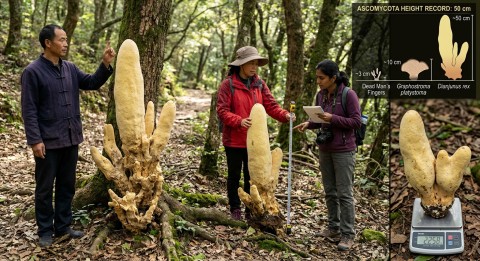
A team from the Kunming Institute of Botany has described Dianjunus rex, a giant fungus from Yunnan whose fruiting bodies reach 50 cm tall and up to 2.2 kg — the largest known in the Ascomycota — placing it in an entirely new family.
A team from the Kunming Institute of Botany, Chinese Academy of Sciences, has discovered a giant fungus in Yunnan whose fruiting bodies grow up to half a metre tall and weigh as much as 2.2 kilograms — the largest documented in the Ascomycota, one of the major fungal phyla. Because it is so distinct from known fungi, the researchers placed it in an entirely new genus and family, naming it Dianjunus rex.
The study, led by associate professor Indunil C. Senanayake, was published in Frontiers in Fungal Biology. The team collected specimens in August–September 2024 in Damaidi Village, Luquan County, Kunming, and in July 2025 in Nanbang Village, Mengla County, Xishuangbanna, and Yipinglang Town, Lufeng City.
Fruiting bodies half a metre tall
The stromata of D. rex grow upright, pale yellow, shaped like a hand reaching out of the ground, between 20 and 50 centimetres tall. The paper's abstract reports individual stromata weighing up to 2.2 kilograms, the largest fruiting bodies recorded in the Ascomycota, greatly expanding the known morphological range of the order Xylariales.
Combining morphology, a four-gene phylogeny and genomic data, the team confirmed the specimens form a distinct evolutionary branch, sister to the family Graphostromataceae, and established the new genus Dianjunus and the new family Dianjunaceae.
How it got its name
The genus name Dianjunus combines a reference to the ancient Dian Kingdom of Yunnan with the Chinese word for fungus, jun, while rex is Latin for king, a nod to its extraordinary size. English-language media have nicknamed it "D-Rex".
A new family from after the dinosaurs
Molecular clock analysis estimates the family Dianjunaceae diverged about 65 million years ago, within a range of 50 to 80 million years — just after the Cretaceous–Paleogene mass extinction that wiped out the non-avian dinosaurs and reorganised life on Earth. The researchers suggest the ecological niches left by dying plants may have given such decomposers room to evolve.
D. rex grows from the roots of dying host plants; the type specimen was associated with the roots of Quercus variabilis. Genomic analysis also found it carries only about half the decomposition-related genes of its closest relatives, a puzzle for further study. More than 6,000 fungal species are documented in Yunnan, and researchers estimate the province's total fungal richness may exceed 100,000 species, with many still to be discovered.
(Photo credit: Nature World News / research team.)
💬 Comments
No comments yet. Be the first!