 N環球

COP31 talks break down with no deal as draft omits fossil fuels and EU refuses to sign
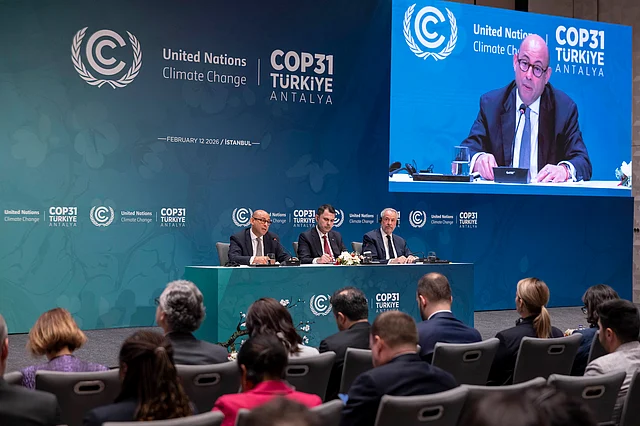
United Nations climate talks ended in failure in Antalya, Türkiye, on Sunday, as nearly 200 countries failed to agree on an overarching deal; the presidency's draft, which did not mention fossil fuels, was rejected by the EU, the UK and many developing countries — the first COP without a deal since Copenhagen in 2009.
United Nations climate talks ended in failure in Antalya, Türkiye, on Sunday (November 22), as negotiators from nearly 200 countries failed to agree on an overarching deal. The draft 'Antalya Pact' put forward by the COP31 presidency collapsed after the European Union, the United Kingdom and many developing countries rejected a text that did not mention fossil fuels at all. It is the first time since the Copenhagen summit in 2009 that UN climate talks have ended without an adopted deal.
A draft without fossil fuels, rejected by the EU
Darragh O'Brien, Ireland's climate and energy minister, speaking for the EU — Ireland holds the rotating EU presidency — said the draft 'failed to meet the moment'. 'We will not endorse a cover decision, or an Antalya Pact, that does not even mention fossil fuels, which is the key driver of climate change,' he told the chaotic closing plenary. The UK, small island states and many developing countries also said they could not support it. Russia and Saudi Arabia, by contrast, backed leaving any explicit mention of fossil fuels out of the final text. The draft did call on countries to electrify their economies, for rich countries to finance adaptation in poorer ones, and to minimise the overshoot of the Paris Agreement's 1.5°C threshold — but it also included a contested goal on carbon capture and storage technology, backed by the oil industry and criticised by campaigners as perpetuating fossil fuels.
44 hours past the deadline, still no consensus
The summit had been scheduled to end on Friday (November 20), but talks dragged into the weekend and were still deadlocked on Sunday afternoon, a record 44 hours past the official close. Murat Kurum, Türkiye's environment minister and COP31 president, told the closing plenary: 'We have done our utmost; ultimately, we have not imposed this text on anyone, nor have we issued an ultimatum such as a take it or leave it demand. It is clear that there are parties in this hall who oppose this text. We recognise that there is no consensus on this document. Therefore, these decisions have not been adopted.' Chris Bowen, Australia's climate and energy minister, who co-chaired the summit with Kurum, called the outcome 'very disappointing'.
How the divide formed
The divide widened over two weeks of talks. An opening draft from Australia on Monday had called for a faster phase-out of fossil fuels; a slimmer version on Thursday removed every mention of them after Saudi Arabia and other major oil and gas producers objected. More than 130 countries had demanded that the text endorse the transition away from fossil fuels, but the final draft only referred to language agreed at an earlier COP, without advancing it. Climate finance, adaptation support and a just transition were equally unresolved. The campaign group CAN Europe called it 'one of the worst COPs we have ever seen', while also arguing that the EU bore responsibility for its own hard line on finance.
What survived, and what happens next
The conference did not collapse entirely: the presidencies passed decisions on various related matters without adopting the cover decision, avoiding a full breakdown of the conference of the parties. The unfinished work now moves to the Bonn intersessional meetings, where governments will have to re-engage at a much higher political level; the next summit, COP32, will be held in Addis Ababa, Ethiopia. Observers noted that the failure does not stop the energy transition — the economic case for renewables, electrification and efficiency keeps strengthening — but without political leadership, implementation of the Paris Agreement will fall further behind. (Sources: PA Media / The Guardian; Euronews; CAN Europe)
💬 Comments
No comments yet. Be the first!