 N環球

Lagarde to Step Down as ECB President on 7 February 2027, About Nine Months Before Her Term Ends
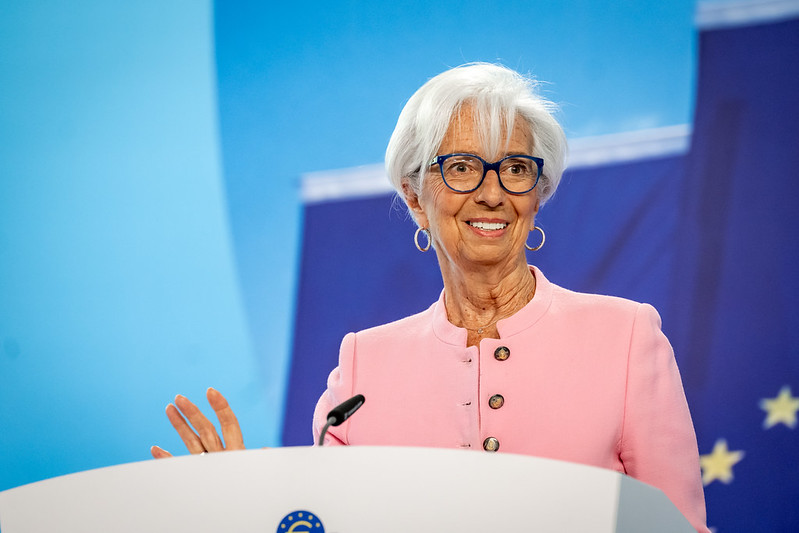
The European Central Bank announced on 29 October that President Christine Lagarde will step down on 7 February 2027, about nine months before her eight-year term was due to expire at the end of October 2027. European Council President António Costa said the process to appoint her successor starts immediately.
The European Central Bank (ECB) announced on 29 October that President Christine Lagarde has informed its Governing Council and European Council President António Costa that she will step down on 7 February 2027. Her eight-year term was due to run until 31 October 2027, so the early departure comes about nine months ahead of schedule.
The timing, and what she said
Speaking at the monetary policy press conference in Frankfurt that day, Lagarde said the obligation of political neutrality imposed on central bankers had become increasingly difficult to reconcile with her personal convictions, saying she did not think she could remain neutral and was not comfortable in that neutrality at the present time. In a post on social media she said she had just informed her colleagues of her decision, and in a video message she said she would leave with a sense of good work done and an ECB fit for the future. She stressed that until 7 February she remains fully in charge and that the continuity of the bank's business will not be affected.
Succession process starts immediately
The ECB said her successor will be appointed by the European Council under the nomination procedure set out in Article 283 of the Treaty on the Functioning of the European Union. Costa said the process was initiated the same day and will proceed without delay, with a view to a timely decision. European leaders will discuss candidates at summits in November and December. Names frequently mentioned in reporting include former Dutch central bank governor Klaas Knot, Bank for International Settlements chief Pablo Hernández de Cos, and Bundesbank president Joachim Nagel.
A seven-year tenure in review
Lagarde took office on 1 November 2019, succeeding Mario Draghi, and was the ECB's first woman president; she had previously led the International Monetary Fund and served as France's finance minister. European Commission President Ursula von der Leyen thanked her for steering the euro area through the pandemic and Russia's war against Ukraine. Her tenure spanned the pandemic-era support measures and the subsequent sharp rate rises to fight inflation. Her departure also coincides with wider leadership turnover: Chief Economist Philip Lane is approaching the end of his mandate, and Executive Board member Isabel Schnabel is set to leave in early 2027 to join the International Monetary Fund.
No official reason given; reporting points to freedom to speak out
The ECB's brief official announcement gave no reason for the early exit. Reuters, citing a source familiar with the matter, reported that Lagarde felt she could no longer remain neutral about French politics and wanted greater freedom to express her views. In February, the Financial Times reported she was considering leaving before France's presidential election in April 2027 so that President Emmanuel Macron, who cannot stand again, could have a say in choosing her successor; AFP reported last month that Lagarde had ruled out standing for the presidency herself. Those reports have not been confirmed by the ECB.
What the successor inherits
The successor will set interest rates for the euro area's 21 member states and more than 350 million people. By the time Lagarde leaves, the ECB has selected 36 payment service providers for a digital euro pilot due to begin in the second half of 2027, with the necessary legislation still to be adopted by EU lawmakers. The ECB said its Governing Council thanked Lagarde warmly and gave her a long standing ovation.
💬 Comments
No comments yet. Be the first!