 N環球

Germany's Q.ANT Unveils Photonic Chip NPU Gen 2+, Running a Large Language Model With Light
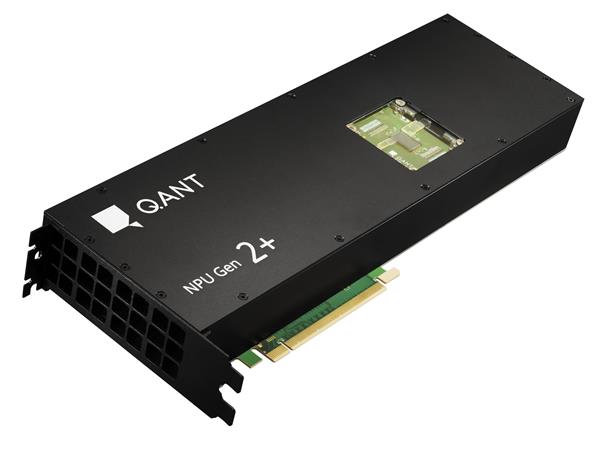
German photonic computing company Q.ANT unveiled the NPU Gen 2+ at the SC26 supercomputing conference in Chicago on November 17, adding optical Discrete Fourier Transforms that perform maths directly in light; a live demo coupled it with an AMD GPU to run a large language model with optics for the first time, with commercial systems planned for the second half of 2027.
German photonic computing company Q.ANT unveiled its latest photonic processor, the NPU Gen 2+, at the SC26 supercomputing conference in Chicago on November 17. The new processor adds optical Discrete Fourier Transforms (DFTs), expanding the mathematical functions developers can run directly in light and enabling faster, leaner AI models and high-performance computing applications that use fewer parameters and less data.
First large language model run with optics
At SC26, Q.ANT demonstrated a hybrid computing system coupling the NPU Gen 2+ with an AMD graphics processing unit (GPU) to run a large language model (LLM) with optics for the first time. The demonstration showed how mathematical functions performed in light can replace a computationally intensive attention layer, addressing a major bottleneck in generative AI. The NPU Gen 2+ performs DFTs in a single operation using the physical properties of light, instead of the sequence of energy-intensive electronic calculations classical computing demands. For data centre operators, integrating photonic hardware opens new capabilities while potentially lowering energy consumption and operating costs significantly.
Thin-film lithium niobate chip; commercial systems due in H2 2027
At the heart of the NPU Gen 2+ is an optical component on a Thin-Film Lithium Niobate (TFLN)-based photonic integrated circuit that directly performs DFTs, a fundamental mathematical operation used in signal and image processing, simulations and data analysis. The processor builds on the NPU Gen 2, launched in 2025 and focused on matrix multiplication and non-linear operations, and retains PCIe integration into standard rack-mountable server systems so it can work as a co-processor alongside CPUs and GPUs. Q.ANT plans to offer commercial systems combining Gen 2 and Gen 2+ processors in the second half of 2027. In September 2026 the company launched an open-source software development kit (SDK) with APIs for C and Python, example applications, documentation and a CPU-based simulation environment, allowing programmers to design and test photonic computing applications without direct access to optical hardware; the SDK has now been extended to support NPU Gen 2+ capabilities, and a photonic pilot with IONOS offers access to real hardware.
CEO: making the next wave of AI affordable
'With Gen 2+, we're opening the door to software that uses what light does naturally. That allows leaner AI models with fewer parameters and less data, and that is what will make the next wave of AI affordable,' said Michael Förtsch, CEO of Q.ANT. The company was founded in 2018 and is headquartered in Stuttgart, Germany, where it operates its own TFLN chip pilot line, with offices in Munich and Austin, Texas. It secured Europe's largest Series A for photonic computing in 2025 and introduced its second-generation processor the same year; its systems are now installed and running at leading scientific computing centres. (Source: Q.ANT/GlobeNewswire)
💬 Comments
No comments yet. Be the first!