 N環球

Google Unveils Gemini 4 Hydrogen, Bringing Gemini 4 to All Users Including Free Tier
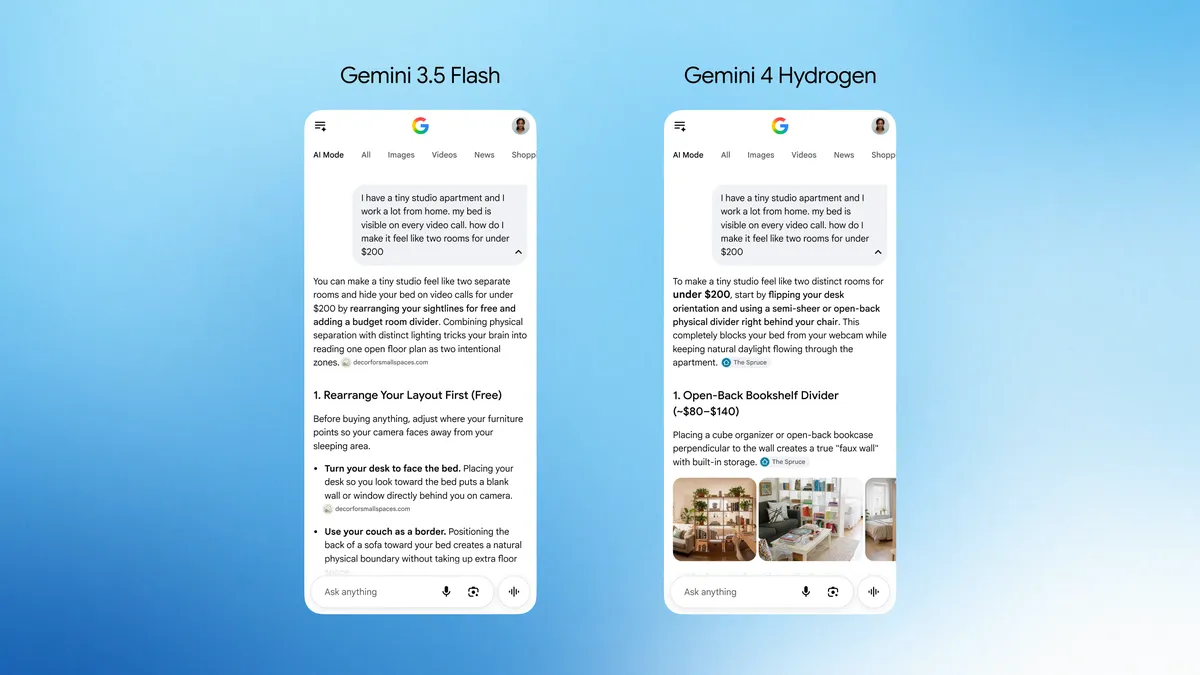
Google on November 12 launched Gemini 4 Hydrogen, built for speed and cost efficiency in everyday coding and agentic workflows. Gemini 4 now reaches all Google Search users, including free users, priced at $1.50 per million input tokens and $7.50 per million output tokens.
Google on November 12 launched Hydrogen, the third model in its Gemini 4 family, built for speed and cost efficiency in everyday coding and agentic workflows. While the flagship models Carbon and Argon handle deep, long-horizon reasoning, Hydrogen is positioned as the everyday execution engine. With its launch, Gemini 4 now reaches all Google Search users, including free users.
2.5x faster than 3.8 Flash, benchmark score more than triples
According to Google, Hydrogen completes tasks 2.5 times faster than the previous Gemini 3.8 Flash at its default high thinking level, while its Terminal-Bench 4.1 score rose from 18.2% to 57% and fabricated claims fell by more than five times. On the Artificial Analysis Intelligence Index, Hydrogen scores 51 at its default setting, slightly ahead of sibling model Argon at 50, and reaches 54 at its highest xhigh thinking level. Hydrogen is priced flat across its full 1-million-token context window at $1.50 per million input tokens and $7.50 per million output tokens.
Four thinking levels to trade speed against depth
Hydrogen offers four thinking levels — low, medium, high (the default) and a new xhigh tier — so users can trade quality, latency and cost against the demands of each task. The model supports 1 million input tokens and up to 1 million output tokens, and can synthesise PDFs, spreadsheets, charts, audio and recorded video into polished, cited reports. Google says Hydrogen matches or beats competing models in its class across developer and enterprise benchmarks, including deep research, data analysis and navigation of large codebases.
Orchestrator: Carbon and Hydrogen divide the work automatically
Alongside Hydrogen, Google is launching Orchestrator in Antigravity, its paid subscription service, which switches models automatically within a single session: Carbon and Argon take architectural judgement and hard debugging, while Hydrogen handles execution such as writing code, running tests and verifying changes. Google says Orchestrator reached near-Carbon task success rates on Terminal-Bench 4.0 while consuming 24% less quota and finishing 19% faster. When several agents run in parallel, Carbon can act as coordinator while Hydrogen powers worker and verifier agents.
Search and the Gemini app get the upgrade too
For ordinary users, the most visible change comes in Google Search and the Gemini app: Search will better understand multi-part questions and typo-heavy queries, give more visual, scannable answers, and connect users to a broader range of relevant sites through improved query fan-out. The Gemini app will follow the user's tone and format more closely, with less back-and-forth, and can call on connected apps such as Gmail and Google Drive to complete multi-step tasks. Hydrogen is rolling out now across the Gemini API, AI Studio, the Gemini app, Google Search and Gemini for Business; paid Pro and Ultra subscribers can also use it in Antigravity.
Safety: overreach sharply down, resilience to prompt injection up
Google says Hydrogen uses the latest Gemini 4 safety stack: overreach in agentic tasks is down by up to 81%, under-service by up to 79%, and misaligned actions and shortcutting across tool-use and coding evaluations by 12 times; when faced with impossible or blocked tasks, it is up to twice less likely to bypass permission boundaries, with a 96.7% honesty rate on the company's internal agent honesty evaluation. Against indirect prompt injection attacks, Hydrogen is more than 2.3 times more resilient on the Gray Swan IPI benchmark. Note that these benchmark figures were published by Google and have not been independently verified; real-world performance remains to be tested by users.
Sources: Google official blog; 9to5Google; Digital Trends.
💬 Comments
No comments yet. Be the first!