 N環球

Google launches Gemini Decision 1: up to 1,000 questions judged in one pass, in 150–250 ms
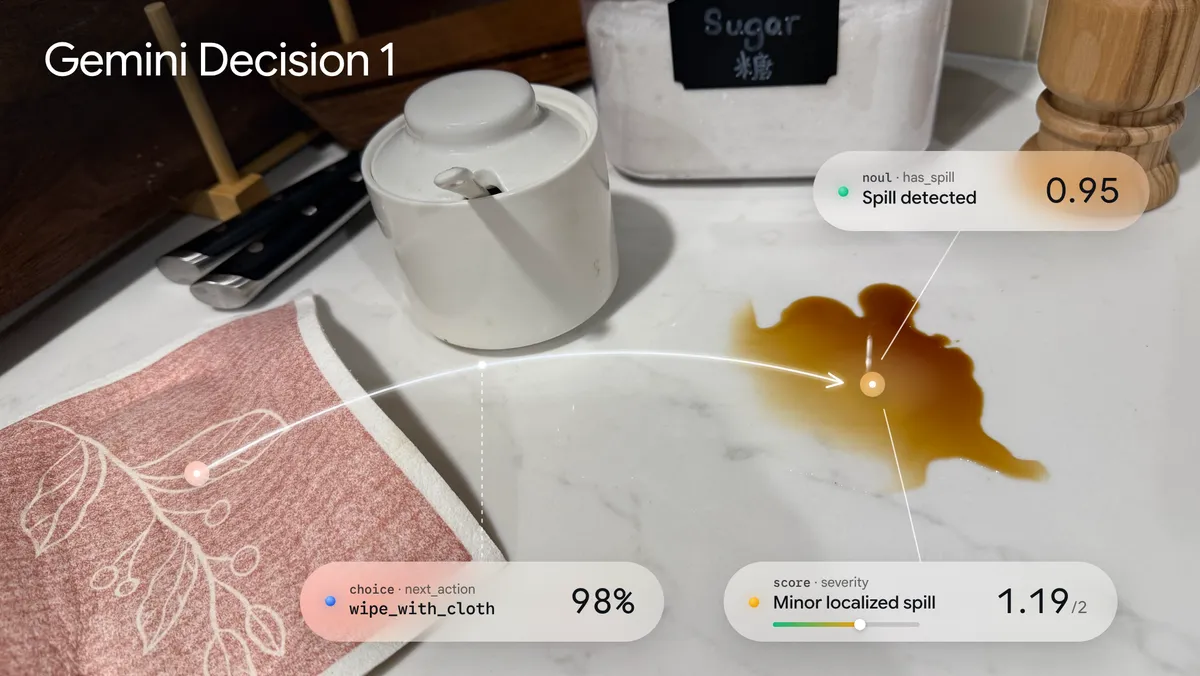
Google on November 11 launched the Gemini Decisions API and a new model, Gemini Decision 1: instead of generating text token by token, the model scores candidate answers, judging up to 1,000 yes/no, choice or rubric questions in a single request with 150–250 ms end-to-end latency.
Google on Tuesday, November 11, launched the Gemini Decisions API and a new model, Gemini Decision 1. Instead of generating answers token by token, the model scores candidate options, judging up to 1,000 yes/no, multiple-choice or rubric-scoring questions in a single request, with end-to-end latency of just 150 to 250 milliseconds.
One input, up to 1,000 questions
Each request can carry one multimodal input — text, image, audio, video or PDF, up to 256K tokens — plus up to 1,000 independent questions. The model scores every candidate option in a single forward pass, returning probabilities and a confidence score from 0 to 1, so code can route ambiguous cases to a fallback or a human. Three question types are supported: yes/no checks, multiple choice with 2 to 255 options, and ordered-rubric scoring, for bounded choices such as tool selection, policy checks, model routing and content grading.
Pricing and performance
Pricing is $0.10 per 1M input tokens with zero output tokens billed; Google says the Decisions API is nearly 5x cheaper across its shared benchmark suite than Gemini 3.5 Flash-Lite with the Interactions API. Median model compute is 50 to 100 ms, and latency stays nearly flat as contexts grow to 16K tokens and questions from 1 to 100 per request. The API is available now through the Gemini API and Google AI Studio (v1beta, with a no-cost tier), with integrations rolling out across OpenRouter, LangChain, Vercel and others; Google Cloud support is coming soon.
Already in use inside Google
Google says Gemini Notebook already uses the Decisions API as a real-time router, directing queries to the right model tier and thinking level and cutting latency for everyday queries by up to 40%; the design tool Stitch, emoji selection in Google Labs' CC, and a safety layer for MCP tools in Search also use it. OpenAI launched a similar Decisions API in September, followed by Microsoft, as the race over “decision-only” models heats up. Sources: Google official blog, Unite.AI, OpenRouter.
💬 Comments
No comments yet. Be the first!