 N環球

Google Unveils TPU 8tx and 8i Max, Its Fourth AI Chips This Year in Challenge to Nvidia
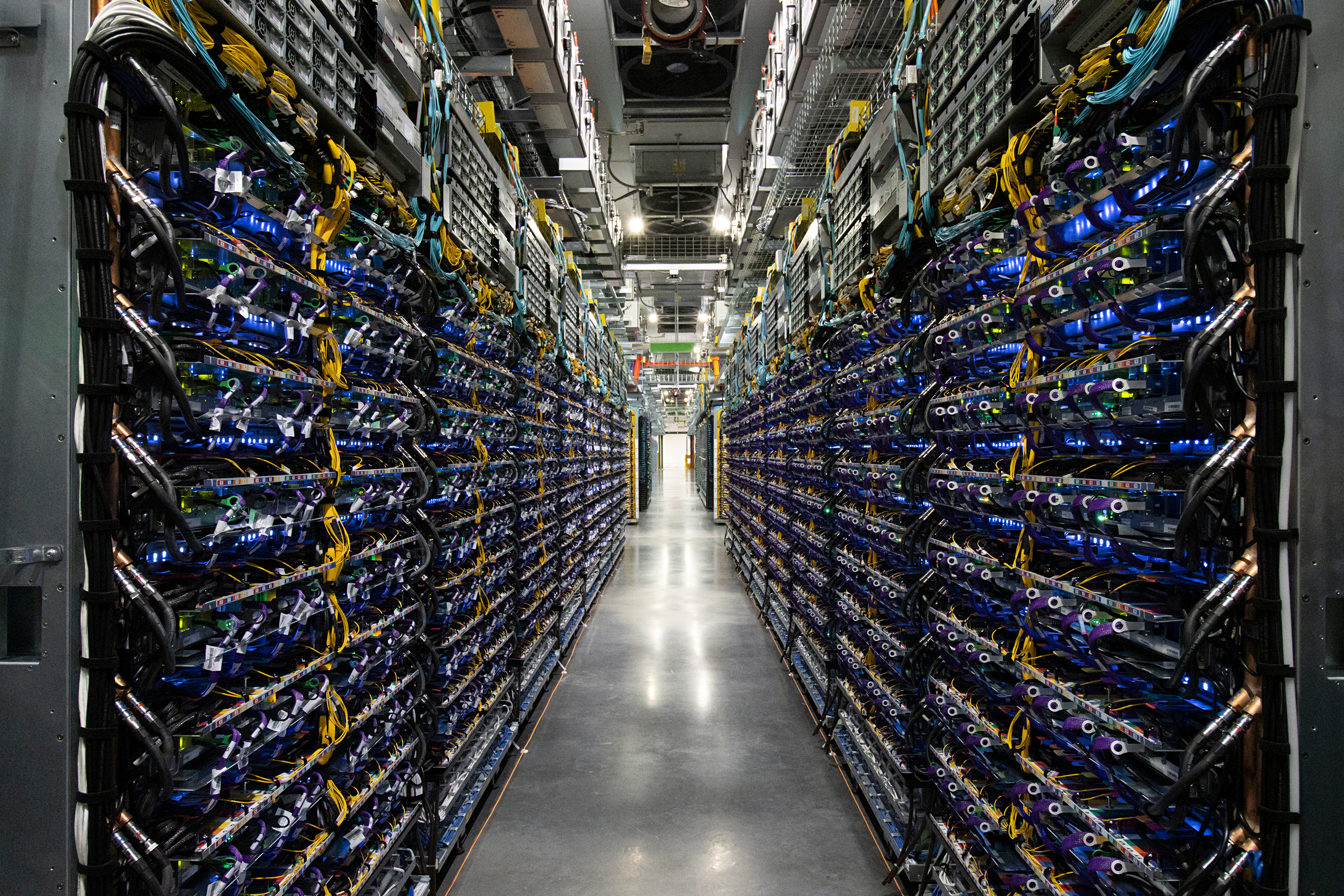
Google Cloud announced two new eighth-generation TPU systems, the TPU 8tx for confidential computing and the TPU 8i Max for massive context windows; it is the first year Google has shipped four TPU systems, and analysts forecast TPU-related sales rising from about $12 billion this year to more than $135 billion by 2028.
Google Cloud on Monday (November 9) announced two new eighth-generation tensor processing unit (TPU) systems — the TPU 8tx and the TPU 8i Max — aimed at confidential computing and long-context artificial intelligence applications respectively. The additions bring to four the number of TPU systems Google has introduced this year, the first time in more than a decade of developing in-house silicon that the company has shipped that many in a single year, escalating its challenge to Nvidia's dominance of the AI accelerator market. (Image: file photo of a Google TPU data centre, courtesy of Google Research.)
8tx targets confidential computing, paired with AMD processors
The TPU 8tx uses the same silicon die as the TPU 8t training chip introduced in April, repackaged for secure and confidential inference alongside small-scale training, and paired with fifth-generation AMD EPYC processors as hosts. The system features chip-level encryption to protect data and model weights while processing is under way, and is aimed at government agencies and companies in regulated industries. Google said the 8tx uses its Boardfly networking technology to deliver up to two times lower latency than the TPU 8t, with a near-zero performance penalty.
8i Max packs two chips to tackle massive context windows
The TPU 8i Max combines two low-latency TPU 8i inference chips in a single package, doubling compute density, static RAM and high-bandwidth memory capacity and bandwidth relative to a standalone 8i. It is designed for AI applications that need very long context windows, such as multi-hour audio, large codebases and long video streams, with use cases including drug discovery, mathematics and programming. A single TPU 8i pairs 288 GB of high-bandwidth memory with 384 MB of on-chip SRAM.
Four systems in a year as specialisation becomes the strategy
Google introduced the TPU 8t for large-scale training and the TPU 8i for real-time reasoning at Google Cloud Next on April 22, 2026; the pair delivers up to 2.7 times the training performance of the previous generation and up to 80% better inference performance per dollar. Amin Vahdat, who leads Google's chip business, said the new products are not entirely new silicon designs but reconfigurations built to meet customer requests, and that the future lies in specialisation. Mark Lohmeyer, vice president of AI and computing infrastructure at Google Cloud, said the company plans to keep expanding its range of specialised chips to reflect the growing diversity of AI workloads.
Nearly 100 customers; analysts see sales rising tenfold in three years
Google said nearly 100 customers, including Oracle, Anthropic and OpenAI, are using its TPU technology, and reports say TPUs cost roughly 30% less than Nvidia GPUs. Bloomberg Intelligence forecasts TPU-related sales, including software and hardware, will grow from about $12 billion this year to more than $135 billion by 2028. Both new systems are expected to ship next year. Supply shortages and opposition to data centres remain constraints on growth.
💬 Comments
No comments yet. Be the first!