 N環球

Ontario Fall Economic Statement: deficit rises to C$16.9 billion, balanced budget pushed to 2029-30
Ontario Finance Minister Peter Bethlenfalvy's 2026 Fall Economic Statement projects a C$16.9-billion deficit for 2026-27, up from C$13.8 billion in the spring budget, with a return to balance delayed to 2029-30.
Ontario Finance Minister Peter Bethlenfalvy tabled the 2026 Ontario Economic Outlook and Fiscal Review, titled A Plan to Protect Ontario, on October 29. The province's Fall Economic Statement concedes that the economic and fiscal outlook has weakened considerably since the spring 2026 budget, as U.S. tariffs and global uncertainty weigh on growth, widen the deficit and push the return to balance back by a year.
A bigger deficit and slower growth
The statement projects a deficit of C$16.9 billion in 2026-27, about C$3.1 billion higher than the C$13.8 billion forecast in the 2026 budget. Deficits of C$12.7 billion in 2027-28 and C$6.7 billion in 2028-29 follow, before a modest C$0.2-billion surplus in 2029-30. Over the three deficit years, the shortfall totals about C$36.3 billion.
Real GDP growth is projected at just 0.5 per cent in 2026, down from 1.0 per cent in the budget, recovering to 1.5 per cent in 2027, 1.8 per cent in 2028 and 2.0 per cent in 2029. The unemployment rate is expected to fall from 7.2 per cent in 2026 to 6.1 per cent in 2029. Net debt to GDP is forecast at 37.4 per cent in 2026-27, slightly below the budget forecast of 37.7 per cent and under the government's 40 per cent target, while net debt to revenue, at 210 per cent, exceeds the 200 per cent target.
For comparison, the statement notes that the actual deficit in 2025-26 was C$13.0 billion, better than the C$14.6 billion forecast in the 2025 budget.
Tax relief and the tariff response
The largest new measure is the proposed Ontario Competitiveness Tax Cut, part of a multi-year tax action plan, providing about C$8 billion in provincial business investment tax relief over five years. The province says it is the provincial component of the federally announced Productivity Mega Deduction, which would let businesses immediately write off 100 per cent of a wide range of assets, and it projects 30,000 new jobs and C$6 billion in additional GDP. The measure is proposed, and its implementation will depend on the legislative process.
The other pillar is the tariff response: the statement reiterates the C$8.7-billion Canada-Ontario industrial action plan for tariff-hit sectors including critical minerals, automotive manufacturing, steel, energy, defence and strategic infrastructure. On infrastructure, the province reaffirmed a C$210-billion, 10-year capital plan covering transportation, energy, housing-enabling and community projects.
What to watch next
For Ontario residents, three questions matter most: whether the proposed tax cut passes the legislature and when it takes effect; how the tariff action plan money is actually allocated to affected businesses and workers; and whether the 2029-30 return to surplus slips again if growth stays weaker than expected. The government says its fiscal plan builds in additional prudence to preserve flexibility amid trade uncertainty.
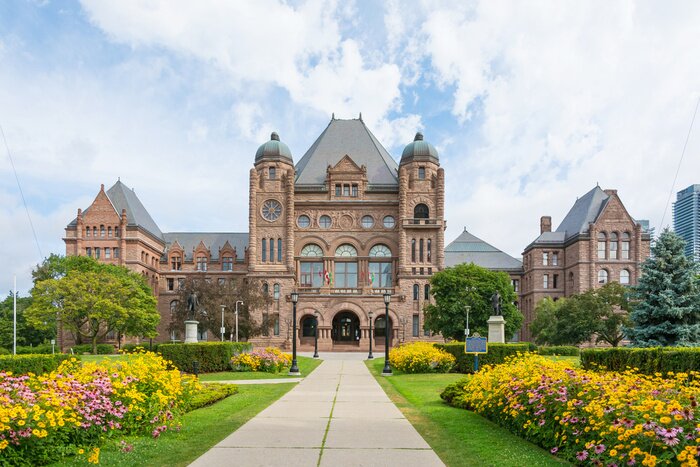
The photo with this article is a file photo of the Ontario Legislative Building. Sources: Ontario Ministry of Finance, 2026 Ontario Economic Outlook and Fiscal Review; OGCA and CFA summaries of the Fall Economic Statement, November 2, 2026.
💬 Comments
No comments yet. Be the first!