 N環球

6,500-year-old Neolithic cemetery unearthed near Paris, with 10-tonne human-shaped statue
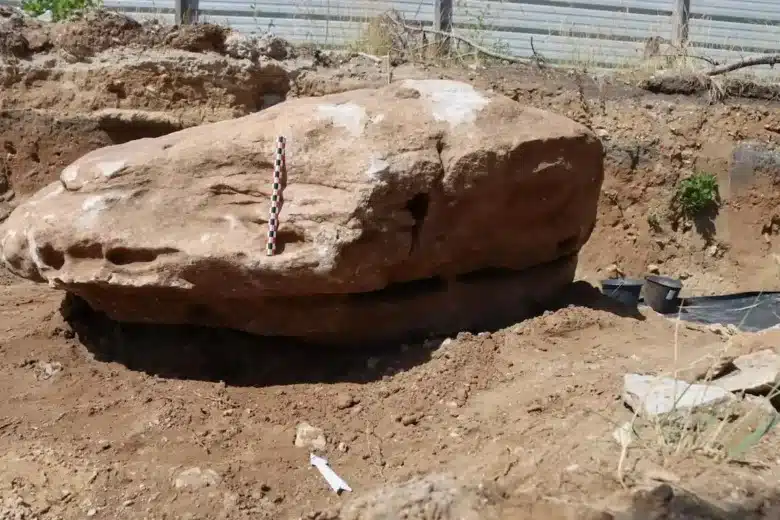
France's national preventive archaeology institute has uncovered a roughly 6,500-year-old Middle Neolithic cemetery at a housing site in Champigny-sur-Marne, south-east of Paris: 11 graves, 30 megalithic stones and a human-shaped statue weighing about 9.7 tonnes.
It was supposed to be a routine dig before a housing project. Instead, archaeologists have uncovered a site unlike anything previously known in the Paris region. France's national institute for preventive archaeology, Inrap, found a roughly 6,500-year-old Middle Neolithic cemetery on a terrace of the Marne River at Champigny-sur-Marne, south-east of Paris: 11 graves, 30 giant stones and a human-shaped statue weighing almost ten tonnes.
A 3-metre statue with an engraved belt, possibly once painted
The statue-menhir measures 3.04 metres long, 1.68 metres wide and 0.74 metres thick, and weighs an estimated 9.7 tonnes. Its surface carries an engraved belt and a series of cup marks, and the whole stone was pecked with repeated blows before any engraving began. Researchers found white and black stains in the tiny pits in the upper left of the main face that could be pigments — if confirmed, the statue would have been painted. It was lying on its side in the wedging pit dug to hold it upright, with two smaller sandstone blocks nearby: one looks like a stela, the other like a miniature menhir, possibly set up to mark the burial area.
Eleven graves, one seated burial with legs encased in calcite
The cemetery dates to the Middle Neolithic, about 4750 to 4300 BC — older than writing and older than the wheel. In the Île-de-France, graves from this period normally appear one at a time and on their own; at Champigny, by contrast, there is a whole group of burials. Eight of the eleven graves are packed into about 60 square metres along the southern side of an earth mound. Grave goods are mostly worked flint, such as blades and points, plus an axe made from local sandstone, and bone tools in two graves. The most striking burial is a narrow circular pit holding a seated adult, whose lower legs and feet are completely trapped in calcite. Inrap's report does not explain why this person was treated differently.
Primitive cement and a mound with no body
The builders also used a primitive cement, made by mixing local sand and silt rich in carbonates with gravel and water, which hardened as it dried. Traces appear in the edges of the graves, in the wedging pits of the statue and the other blocks, and in the mound itself. In the south-east of the plot sits a mound of fine brown earth covering about 30 square metres, topped by a small stela broken in two — yet beneath it lay no grave, and Inrap itself asks whether it served as a landmark in the landscape. It is the first burial ground with megalithic monuments found in the Île-de-France. The team now plans ancient DNA and isotope analyses to reveal the age, sex, health, diet, origin and mobility of those buried there. Sources: Inrap; Archaeology Magazine; The Daily Galaxy.
💬 Comments
No comments yet. Be the first!