 N環球

Ambarella and Liquid AI Partner to Bring Agentic AI Onto Edge Chips for Physical AI
Edge AI chipmaker Ambarella and efficient foundation-model developer Liquid AI have announced a strategic collaboration to run Liquid's LFM3 models on Ambarella's CVflow architecture, letting perception, reasoning and decision-making happen directly on devices with less reliance on the cloud; the models are now in Ambarella's Cooper Model Garden, with demos planned for CES 2027.
Edge AI semiconductor company Ambarella and efficient foundation-model developer Liquid AI announced on Tuesday (November 24) a strategic collaboration to bring Liquid's LFM3 foundation models onto Ambarella's CVflow AI architecture, enabling perception, reasoning, decision-making and action directly on devices for physical AI applications. No financial terms were disclosed.
LFM3 now in the Cooper Model Garden; support planned for CV72, CV75, N1-655 and X7
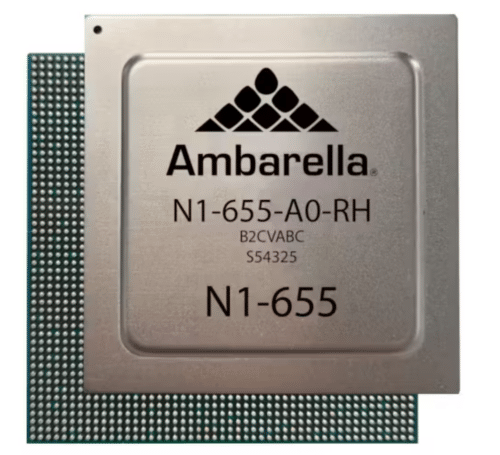
Liquid's models are now available in Ambarella's Cooper Model Garden in its Developer Zone, so developers can build applications using Liquid models running directly on Ambarella silicon. The companies plan to extend support for more Liquid models across Ambarella's portfolio, including the CV72, CV75 and N1-655 systems-on-chip and the X7 AI accelerator, and to show demos of solutions built with Liquid's LFM3 models on Ambarella SoCs at CES 2027.
On-device inference cuts cloud dependence, memory and power
The joint work initially focuses on Liquid's LFM3 family of Liquid Foundation Models, introduced in October, optimised through the CVflow architecture for lower AI compute and memory use. The companies say running inference on the device reduces dependence on continuous cloud connectivity, improves responsiveness and privacy, and — with DRAM supply constrained and memory prices rising — lets more capable AI systems be deployed at lower overall hardware cost. Target applications include intelligent security and smart infrastructure, where systems must interpret complex visual and contextual information and act in real time.
What the two companies said
“Physical AI represents a fundamental evolution in artificial intelligence, where intelligence moves beyond centralized data centers and into the devices that interact directly with the physical world,” said Muneyb Minhazuddin, Customer Growth Officer at Ambarella. “These systems must do much more than recognize objects or process individual sensor inputs. They must understand context, reason about their environment, make decisions and take actions in real time.” Erika Wool, Liquid AI's Head of Business, said bringing agentic AI into the physical world “requires a fundamentally different approach to AI architecture”, with intelligence operating where data is generated, within the power, memory and latency constraints of real-world devices.
Background on the two companies
Ambarella says more than 50 million of its AI SoC units have shipped, used in physical security, vehicle safety, telematics, autonomy, portable video, aerial drones and other edge applications. Liquid AI describes itself as a device-native foundation model company; its open-weight flagship Liquid Foundation Models are designed to run efficiently on devices, and its products also include the software infrastructure needed to deploy and operate autonomous AI agents.
(Pictured: an Ambarella N1-655 edge AI chip. File photo. Image: Electronics For You.)
💬 Comments
No comments yet. Be the first!