 N環球

IBM unveils next-generation quantum chip Nighthawk r3: 520 qubits, targeting 1,000-plus in 2027
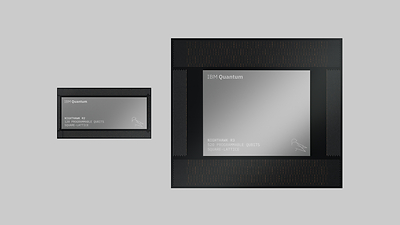
IBM announced its next-generation quantum processor, Nighthawk r3, designed to accurately execute 10,000 quantum operations across 520 programmable qubits; in 2027 it plans to link two r3 processors into a 1,040-qubit system.
IBM announced on Tuesday (11 November) its next-generation quantum processor, Nighthawk r3, designed to accurately execute 10,000 quantum operations across 520 programmable qubits for larger, more complex computations; in 2027 it plans to link two r3 processors into a single 1,040-qubit system, advancing toward fault-tolerant quantum computing.
r3: designed to scale beyond 1,000 qubits
r3 extends the high-speed architecture of r2, designed to support 520 programmable qubits and 2,034 total physical qubits, retaining r2's square-lattice connectivity and fast operations while introducing 10 chip-to-chip interconnects, called l-couplers, to connect processors into larger systems. IBM said it has demonstrated two critical modular technologies: this year it connected two Nighthawk r1 processors using four l-couplers, achieving 99.3 percent quantum state transfer fidelity (against a 99.9 percent target), and connected two cryogenic modules into a single system for the first time, reaching operating temperature in under five days and cooling below 15 millikelvin.
r2 in production: 34 billion circuits, speedups of up to 19x
The current Nighthawk r2, introduced in September, has 120 qubits, delivers up to 100,000 samples per second and supports accurate computations with more than 7,500 quantum operations. Clients and partners including E.ON, Algorithmiq and Q-CTRL have run more than 34 billion circuits on r2, reporting speedups of up to 19x: E.ON reported a 15x speedup in quantum machine learning for energy grid optimisation; an IBM experiment with Oak Ridge National Laboratory simulating real magnetic materials ran 12x faster, with results consistent with neutron scattering experiments; and an Algorithmiq experiment simulating a heterogeneous quantum material ran 8 times faster than on Heron, while simulating it classically with leading tensor-network methods would need an estimated 240 times more memory.
Quantum meets classical computing
IBM is also uniting high-performance classical computing with quantum computing in a single managed environment, the IBM Quantum Platform: IBM and RIKEN scientists executed their sample-based quantum diagonalisation workflow roughly 5 times faster while performing 100 times more computations, and Cleveland Clinic and RIKEN automatically processed 608 million samples for modelling biologically relevant structures, 33 times faster. IBM recently launched a co-design platform for quantum error correction with Oak Ridge National Laboratory and AMD, physically co-locating Nighthawk with ORNL's Umbra supercomputer, powered by AMD Instinct MI355X GPUs and 5th Gen AMD EPYC CPUs. "Useful quantum computing hinges on whether results can be delivered with accuracy and speed, both are fundamental," said Jay Gambetta, Director of IBM Research.
(Image: IBM. Render of the Nighthawk r3 (left) and r2 (right) processors.)
💬 Comments
No comments yet. Be the first!