 N環球

Nvidia's Vera Rubin sweeps MLPerf training tests, claims 10x agentic inference efficiency over prior generation
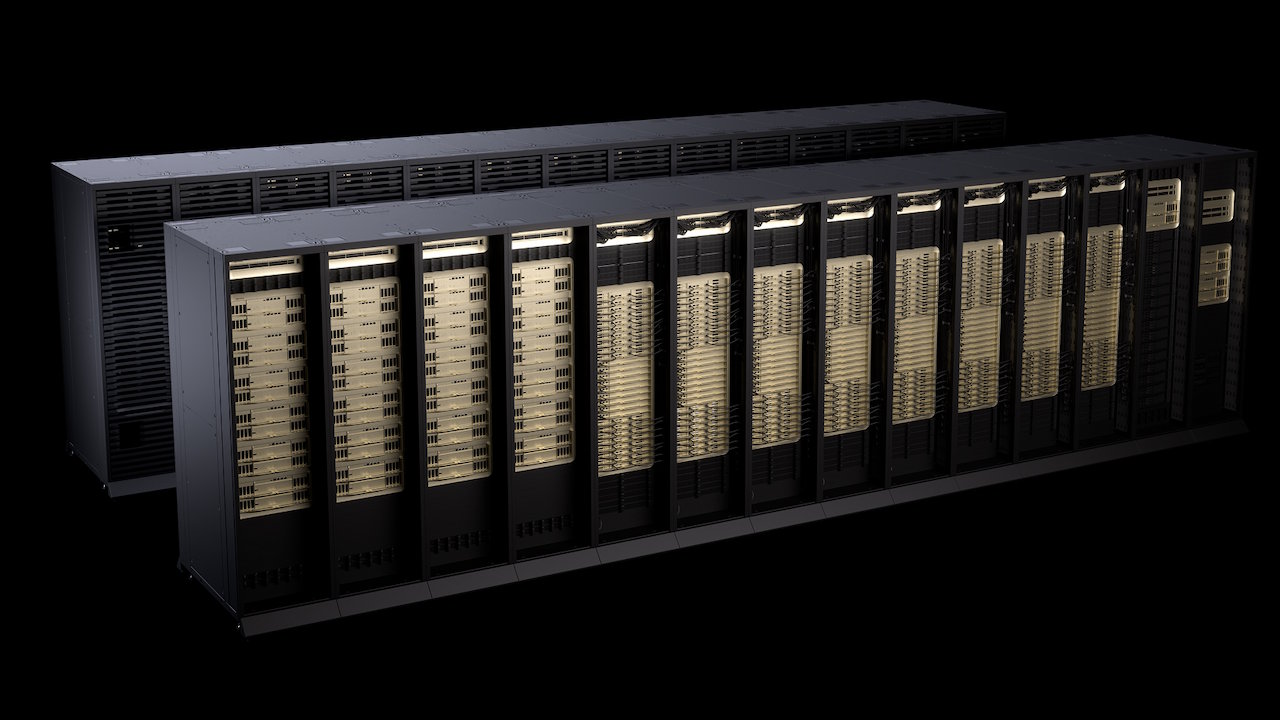
Nvidia said on 16 November that its Vera Rubin platform won every MLPerf Training v6.1 benchmark, and its first MLPerf Endpoints submission for agentic inference claims more than 10x the throughput per watt of the previous GB300 NVL72 generation — though the agentic figures are provisional and still await MLCommons verification.
Nvidia said on 16 November, during the SC26 supercomputing conference in Chicago, that its Vera Rubin platform swept every benchmark in the MLPerf Training v6.1 round, becoming the only platform with results on every test; its first MLPerf Endpoints submission for agentic inference claims more than 10x the throughput per watt of the previous-generation GB300 NVL72. The results were published on Nvidia's official blog, and MLCommons released the full round the same day.
Training: a clean sweep, about 97% scaling efficiency
MLPerf Training measures how fast systems train a range of AI models to target accuracy, spanning large language models, image generation, recommender systems and post-training reinforcement learning. In this round, Vera Rubin NVL72 delivered up to 2x more performance per GPU than the highly optimised GB300 NVL72. On the DeepSeek-V3 benchmark, Vera Rubin scaled from 256 to 1,024 GPUs at about 97% efficiency, cutting training time from 16 minutes to about four. Nvidia also ran the benchmark on 10,240 GPUs with GB300 systems, the largest scale in the round.
Agentic inference: the 10x figure still awaits verification
In its first MLPerf Endpoints submission, Nvidia published a provisional result on Kimi K3, an open model built for agentic workflows: a Vera Rubin NVL72 system with 32 accelerators posted 41,414.2 tokens per second at 100.89 kW, against a GB300 NVL72 system with 48 accelerators at 2,210.4 tokens per second and 60 kW. Nvidia's blog flags clearly that the Vera Rubin Endpoints figures are provisional, pending MLCommons Association verification and subject to change on peer review; the GB300 figures are verified. Readers should treat the 10x efficiency claim as a vendor-published provisional result, not a verified final figure.
Scale of the round and cloud results
MLCommons said Training v6.1 drew 24 submitting organisations, 153 systems and 250 results, adding two new benchmarks: the DLRMv4-HSTU recommender and the Qwen3.5-397B large-scale LLM post-training test. Hardware in the round included Nvidia and AMD accelerators, and for the first time Rubin-generation GPUs and Google's TPUv7 (Ironwood). Cloud provider CoreWeave announced the same day that it was the first cloud provider to submit multi-rack Vera Rubin results: it trained the 671-billion-parameter DeepSeek-V3 to target quality in 17.65 minutes on 256 Rubin GPUs, 2.7x faster than its own GB200 submission at the same scale, and completed Llama 3.1 8B in 7.16 minutes on a single 72-GPU rack, 1.9x faster than GB200. CoreWeave notes its speedups are derived from published results and are not verified by MLCommons.
Context: a pivotal week before earnings
This is Nvidia's second major SC26 announcement this round, following the Nemotron for Science research-agent package. Nvidia reports quarterly results on Tuesday 17 November, its first earnings since founder Jensen Huang resigned as chief executive on 12 November and chief financial officer Colette Kress became interim chief executive; investors are watching shipment progress and demand signals for the new platform, and the MLPerf results read as the company's bid to show technical leadership ahead of the report.
💬 Comments
No comments yet. Be the first!