 N環球

OpenAI says GPT-6 can design proteins: 35 of 322 lab samples bound their targets
OpenAI published a preprint on November 24 saying its GPT-6 models can design new protein structures using only reasoning and general-purpose code; lab tests with research partner Onava found 35 of 322 minibinders bound their targets, though the work is not yet peer-reviewed and still relied on specialist models for parts of the pipeline.
OpenAI published a preprint on November 24, titled “GPT-6 models demonstrate intrinsic protein-design capabilities,” saying its GPT-6 family can design new three-dimensional protein structures and amino-acid sequences using only reasoning and general-purpose code, without a specialist biology model doing the design step. The paper has not yet been peer-reviewed.
Lab tests: 35 designs bound their targets
Working with research partner Onava, OpenAI had minibinders designed by GPT-6.2 built and tested in the lab. Of 322 samples tested against five target proteins — PD-L1, IL-7Rα, TrkA, VEGF-A and IL-17A — 35 showed evidence of binding, a hit rate of about 10.9%. By target, IL-17A had 18 hits, VEGF-A 8, PD-L1 5, IL-7Rα 3 and TrkA 1.
Sequence redesign and antibody design also worked
In sequence-redesign tests, GPT-6.2 proposed new amino-acid sequences for existing protein structures: 75 of 88 designs bound MDM2, 26 of 42 bound VEGF-A, and 8 of 59 bound PD-1. Antibody binding-loop redesigns also succeeded: 128 of 182 variants kept binding to IL-4Rα, and 179 of 272 therapeutic antibody fragments kept binding to PD-1 or PD-L1.
The limits are stated plainly
OpenAI acknowledges the pipeline was not end-to-end general-purpose: the specialist model SolubleMPNN supplied the amino-acid sequences needed to turn shapes into testable proteins, while Boltz-2, OpenDDE and ESMFold2 helped screen candidates. The paper states the results do “not yet establish” that the models can design minibinders end to end without help from specialist models. Full protein-structure prediction also remains a clear weakness: the GPT-6 model averaged a TM-score of 0.38, versus 0.93 for the specialist ESMFold2. Binding in an assay is not biological function, and the paper publishes no affinity, potency or toxicity data.
A new frontier for general-purpose models
Protein design is a key step in drug development: small proteins that bind precisely to disease-related targets can become starting points for new medicines. OpenAI’s claim is that a single general model can handle work that previously needed several specialist models; across 14 computational protein tasks, its newest models matched or beat specialist tools on most. Those strongest performance claims are vendor-reported and still await independent validation.
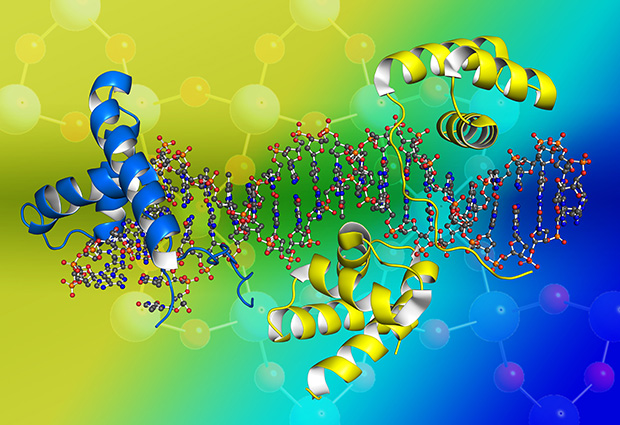
Sources: OpenAI preprint and research announcement; Cryptopolitan; AI Weekly. The image is an illustration of a protein binding to DNA, not a picture of this experiment.
💬 Comments
No comments yet. Be the first!