 N環球

FCC authorizes SpaceX to deploy up to 1 million AI data-center satellites
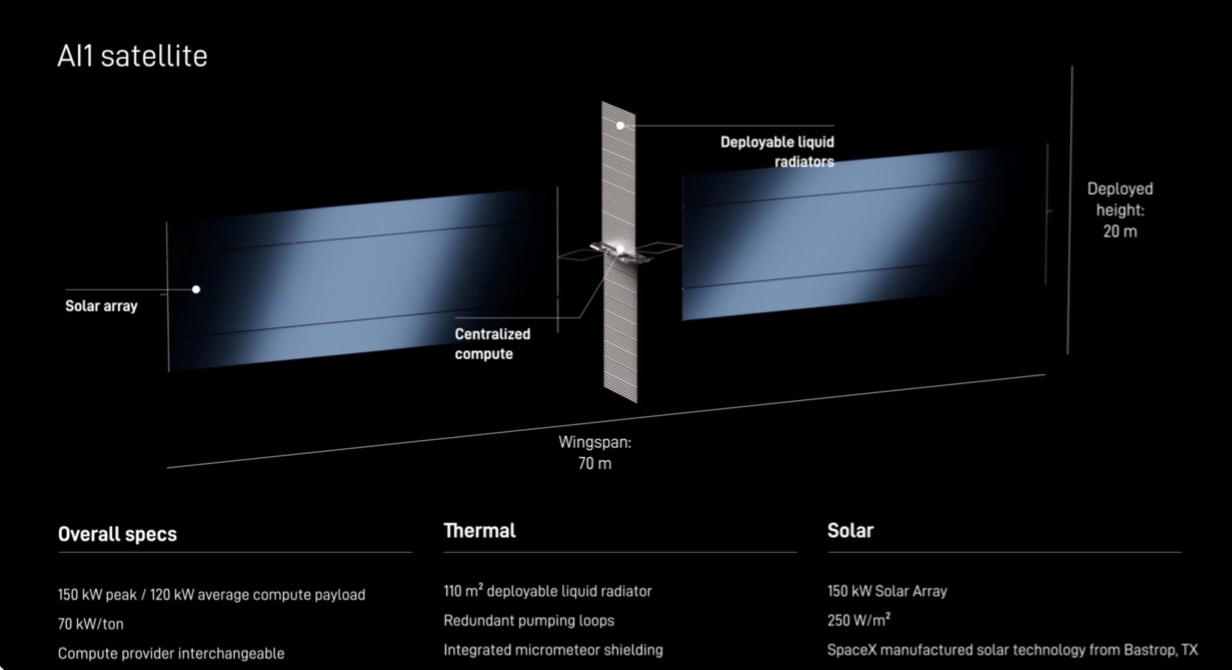
The U.S. Federal Communications Commission has authorized SpaceX to deploy up to 1 million 'Starmind' orbital compute modules forming an AI data-center constellation in space, to be completed by 2040 — the first authorization of its kind in U.S. history.
The U.S. Federal Communications Commission (FCC) on Wednesday, November 25, authorized SpaceX to deploy up to 1 million 'Starmind' orbital compute modules, forming an AI data-center constellation in space. It is the first authorization in U.S. history for a constellation of data centers in space, aimed at meeting rapidly growing demand for AI computing power.
Deployment schedule: complete by 2040
Under the FCC's order, SpaceX must place at least one authorized satellite into its assigned orbit no later than November 25, 2033; deploy 10 percent (100,000 satellites) by November 25, 2035, and 50 percent by November 25, 2038, and complete the constellation by November 25, 2040. The satellites will be deployed into orbital shells spanning 50 kilometers each, at altitudes from 500 to 1,002 kilometers.
The first-generation Starmind satellites will be based on an optimized Nvidia Vera Rubin NVL 72 system, powered by the sun, with laser links between satellites and radio-frequency links as backup and for emergency telemetry, tracking and control. SpaceX also plans to develop a reference design based on Google's TPUs. Elon Musk has said deployment will start in the fourth quarter of 2027 and reach 'significant scale' in 2028; hitting the schedule depends heavily on Starship, the rapidly reusable rocket.
Objections rejected
The FCC rejected petitions to deny the plan from Amazon Leo, Viasat and the American Astronomical Society. The commission found that SpaceX's orbital debris mitigation plan complies with its rules and that the satellites are designed to fully burn up on reentry. SpaceX must also file semi-annual reports on close approaches between objects in orbit, deployment numbers and related data.
The race for computing power in orbit heats up
The approval extends the competition for AI data centers into space, where solar power and cooling are seen as more plentiful than on Earth. There are only about 17,000 satellites in orbit today, and 1 million is an authorized ceiling — whether it can actually be built remains to be seen. Google is pursuing a similar effort, Project Suncatcher, which launched its first prototype satellite in October. The FCC said it is continuing to review other orbital data-center proposals, including from Orbital Inc., Nvidia-backed Starcloud and Jeff Bezos' Blue Origin.
FCC Chair Brendan Carr announced the decision on X; Musk replied that it 'will be a great asset for America and the world.'
(Rendering of SpaceX's first-generation AI1 Starmind satellite. Image: SpaceX.)
💬 Comments
No comments yet. Be the first!