 N環球

NTU Develops Energy-Efficient Chips for On-Device Generative AI, Reaching 157 TOPS/W
A National Taiwan University team has developed two generations of chips for on-device generative AI, with peak efficiencies of 99.2 and 157 TOPS/W; the second generation is 1.6 to 7.6 times that of advanced transformer learning processors.
A team of electrical engineering researchers at National Taiwan University (NTU), led by professor Yang Chia-hsiang, has developed two generations of energy-efficient chips designed to support generative artificial intelligence directly on devices, Taiwan's National Science and Technology Council (NSTC) said on November 25. Central News Agency reported the same day, and the Taipei Times carried the story on November 26.
Two generations, sharply higher efficiency
The first-generation chip, made on a 40-nanometre process, is the first reported learning processor able to accelerate both transformer inference and training, reaching a peak energy efficiency of 99.2 tera operations per second per watt (TOPS/W). The second generation simplifies training further and cuts computing and memory needs, with a peak of 157 TOPS/W — 1.6 to 7.6 times that of advanced transformer learning processors. The second-generation chip was presented at the 2025 Symposium on VLSI Technology and Circuits.
On-device AI: generative AI without the cloud
On-device generative AI means running generative AI models directly on phones, computers and other devices, without sending data to the cloud — a benefit for privacy and latency. Power has long been the main bottleneck for on-device AI: batteries and cooling are limited, so chips must do heavy computation at very low power, which is what the NTU team set out to address.
Next step: the memory bottleneck
The team said it is working on a third-generation processor aimed at the memory bottleneck in AI processing, to further improve the ability of on-device hardware to run large models. (Sources: Central News Agency / Taipei Times)
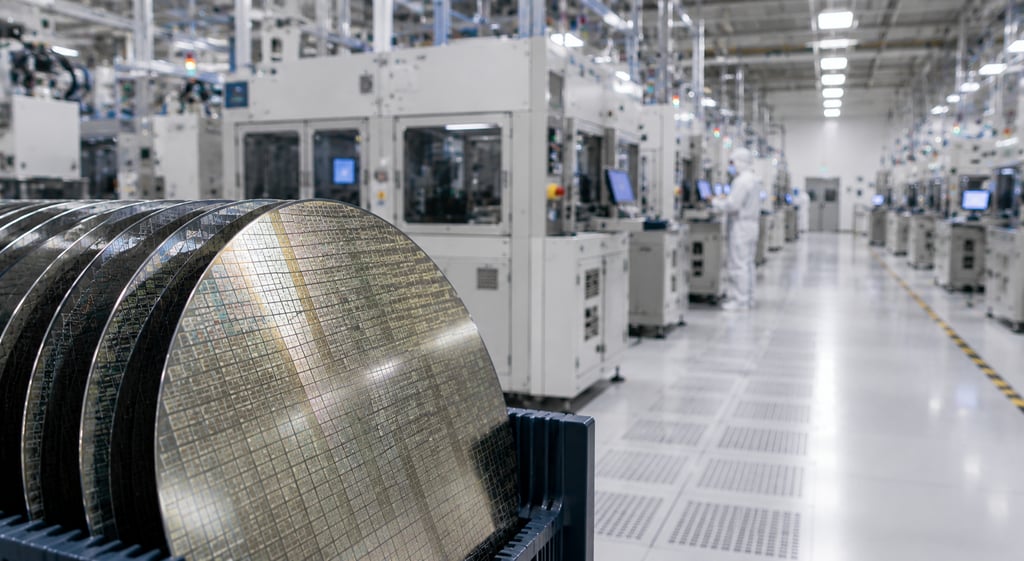
File photo: a semiconductor wafer production line (not the NTU laboratory). Photo credit: Channel Insider.
💬 留言
暂时还没有留言,来抢沙发!